
How Long to Run Sprinklers in Maplewood, Zone by Zone
Aim each zone at its share of 1 to 1.5 inches of water a week, run it between 4 and 10 a.m., and let the head type and the soil decide the minutes.
Free, no-obligation estimates. We answer or call back the same working day.
How long to run sprinklers per zone
Run each zone long enough that the lawn gets about 1 to 1.5 inches of water a week in total, rain included; the minutes can differ from zone to zone because the head type and the soil differ.
There is no single number of minutes that fits every "zone", the group of heads one valve runs. A zone of spray heads reaches its share far sooner than a zone of rotors, and a zone on heavy soil has to take its water in shorter runs. So the target is the inches, and the controller's minutes are whatever it takes each zone to get there.
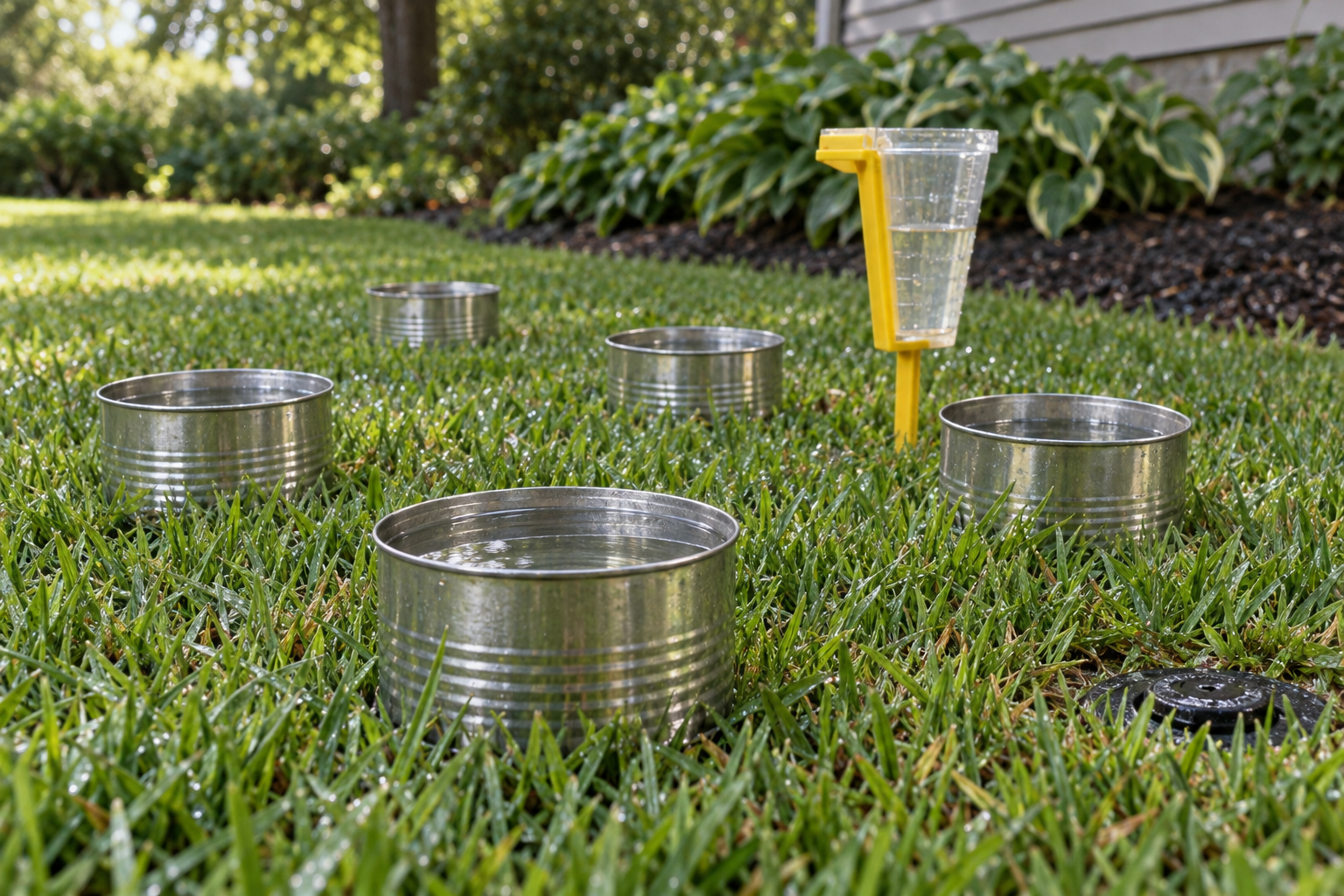
You can measure what a zone actually puts down with a few empty cans and a rain gauge:
- Set straight-sided empty cans across one zone, some near the heads and some halfway between them.
- Run that zone alone from the controller for a set number of minutes.
- Measure the water in each can and average the depths.
- Scale the minutes so the zone's weekly total, plus what the rain gauge caught, lands in the target.
If one can fills and the next stays nearly dry, the zone has a coverage problem, a clogged nozzle, a tilted head or poor head spacing, and no timer setting will fix it.
Early morning watering
Water between 4 and 10 a.m., when the sun and wind are low, so less water evaporates before it soaks in and the grass dries off during the day, which cuts the risk of disease.
The EPA WaterSense watering tips say the same about the middle of the day, and they count rainfall toward the weekly total. Here is how the hours of the day compare for a lawn:
-
Best window
Early morning, 4 to 10 a.m.
The air is cool and still, the water soaks in before the heat, and the blades dry as the sun comes up. Set every zone's start time inside this window.
-
Midday and afternoon
Sun and wind take a share of the water before it reaches the roots, and spray drifts off the lawn onto the walk and the drive.
-
Evening and overnight
Little evaporates, but the grass stays wet for hours in the dark, and wet blades overnight are what lawn disease needs.
One zone dry however long it runs?
Then the minutes are not the problem. A clogged nozzle, a stuck head or a leak is, and that is the work we do. Call, tell us which zone, and we will set a time.
We answer the phone or call back the same working day.
Run times by head type
Spray heads put water down faster than rotors, so a spray zone can run fewer minutes than a rotor zone and still reach the same inches.
Most systems use both kinds of head, each aimed and set for the right amount of water, and each zone holds just one kind so a single run time suits every head on it. Side by side, the difference looks like this:
-
Spray heads
A fixed fan of water over the whole pattern at once.
- How fast
- Fast. Every part of the pattern is wet the whole time the zone runs.
- Where they fit
- Narrow strips, small lawn areas and the edges along the walk and the drive.
- Run time
- Shorter, and often split into cycles so the water does not run off before it soaks in.
- What goes wrong
- A clogged "nozzle", the tip that shapes the spray, leaves a dry wedge in the fan.
-
Rotors
A single stream that turns slowly across a wide arc.
- How fast
- Slow. Each patch of grass gets water only when the stream sweeps past it.
- Where they fit
- Larger open turf areas, where a fan of spray would not reach.
- Run time
- Longer, so the stream makes enough passes to put down the zone's share.
- What goes wrong
- A rotor that stops turning soaks one spot and leaves the rest of its arc dry.
Soil, slope and shorter sprinkler cycles
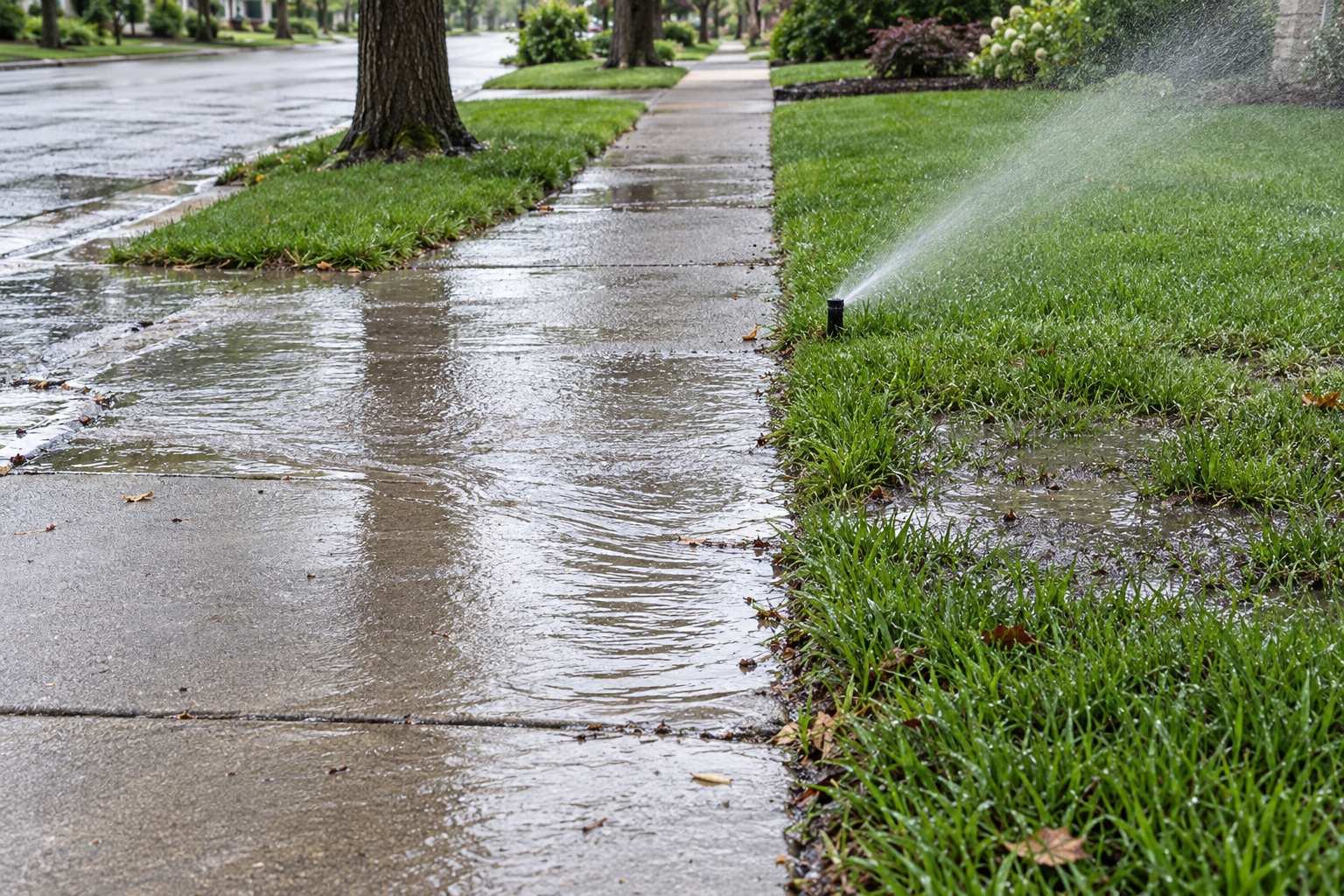
Clay soil takes up water slowly, so a zone on clay can have its minutes split into shorter cycles with a soak between them, and the water goes into the ground instead of pooling or running off.
The trade's word for how fast water soaks in is the "percolation rate", and it is weighed against how fast the heads put water down. When the heads are faster than the soil, everything after the first few minutes runs down the slope and onto the walk. Splitting the same total into shorter runs fixes that without cutting the water the lawn gets.
One long run on clay
The same total in short cycles
Hydro-zoning turf and beds
Zones are grouped by the water needs of the turf and plants they serve, a practice the trade calls "hydro-zoning", so each zone gets its own run time instead of a compromise.
A well-laid-out system keeps these kinds of ground on separate valves:
-
Open lawn in full sun
Open turf in the sun dries out fastest, so its zone usually carries the longest minutes.
-
Lawn under shade trees
Shaded turf loses less water, so on the same valve as the sunny lawn it would stay soggy.
-
Strips and edges
Boulevard strips and narrow side yards run on spray heads, in short cycles that keep water off the concrete.
-
Beds and shrubs
"Drip irrigation" puts low-flow water at the roots of the beds, on a zone and a schedule of its own.
When a sunny lawn and a shaded bed share a valve, one of them gets the wrong amount whatever the controller says.
Letting a smart sprinkler controller set run times
Yes: a smart controller can change the watering schedule on its own, working with its weather sensors as rain, temperature and humidity change. It still runs the zones you set up, so the grouping and the heads have to be right first, and a "rain sensor" alone simply stops watering when it rains.
smart sprinkler controllerWhat neighbors say about our sprinkler work
Our Google reviews, as the people who called us wrote them.
Glenn with Rainmakers Irrigation is super cool, awesome and trustworthy. We are in Woodbury and almost the whole block on our street goes to Rainmakers for sprinkler installation, general maintenance, winterization, and spring startups. Their services are top notch, responses are timely, and prices are affordable. I would recommend Rainmakers Irrigation to anyone who is out shopping for a service provider to install, expand, or service an irrigation system.
Absolutely great company to deal with .I was quoted by a different company that I needed a whole new irrigation system rainmakers came out and fixed a leak and replaced two sprinkler heads and got my system up and running and saved me $2700.00 dollars .if you need irrigation work done give them a call there an honest family owned local business.
Always responsive...Always Fast...Always done right. LOVE THESE GUYS.
Want every zone putting down the right water?
Call and tell us what the lawn is doing. We will run the system zone by zone, fix what is keeping a zone from its share, and quote the whole job before we start.
- Free, no-obligation estimates
- No surprise charges after the quote
- We show up when we say we will